Tuesday, August 30, 2011

THE LITTLE THINGS - THE GREAT TEXAS DROUGHT

The drought here in East Texas has reach what the experts call "Exceptional."  I'd agree with that.  In my half-century of life this is the first time I have seen trees turning brown in midsummer all across the state.  Even though I have watered my garden regularly, the heat apart front the dryness is killing the plants.  Even the weeds are dying!  The exceptionally hardy Bahia grass is even struggling.


It is so hot that fires are starting spontaneously.  As we drove last weekend to Austin, there were numerous scorched areas, some still smoldering along the highway.  We even saw the remnants of a truckload of hay burning along the highway!  According to the local firemen responding, the truck had come out of Mississippi with a large load of rolled hay bales.  Somehow it had caught on fire.  They had offloaded the truck and saved it from damage, but the cargo was lost!

Back home the lawn had turned brown and crunchy and the shrubbery and plantings are dying.

The positive side of this is that there are no flies, mosquitoes or roaches.  The mice are almost gone and we haven't seen much of the usual varmints like coyotes, skunks or raccoons.  I haven't had to mow the lawn all summer and


Even so, we are looking forward to rain. I am eager to plant the fall garden and get back to being able to burn in the backyard.

After the Response in Houston earlier this month, I expect we shall see rain in abundance in due time.  God does answer prayer after all!


Monday, August 29, 2011

THE LITTLE THINGS - RESOLING THE BOOTS

I have a pair of black leather combat booths that I wore during my enlistment in the Texas State Guard some years ago.  Unlike most such boots I have owned, these are quite light and comfortable.  The result is that I wore them in preference to my other boots, and they eventually wore through on the soles.  I kept the upper parts well polished and so these are in good condition.  However, when I asked at the shoe repairer if they could be fixed, they said they didn't fix that type of construction.

MY FAVORITE BOOT WITH WORN-THROUGH SOLE
Six years ago the boots cost about $25.  Now, comparable boots are around $35. If they could be resoled, it would cost almost as much.  I have other boots, but am reluctant to throw these away since they wear much better.  So I looked about to see what was available to repair them with.  The results were a truck innertube and some Gorilla brand glue.  Some newspaper, a bottle of isopropyl alcohol (IP) a sharp pair of scissors, a pair of hand weights and a sharpie were all that were needed to carry out the plan.

TRACING THE HALF SOLE
First, a large section of inner tube rubber was cut off and laid flat.  Then the half-soles were traced with a Sharpie marker.  The half soles were then cut out, one for each boot, and these were check for fit on the sole of the boot. 

The next step was to thoroughly clean both the boot sole and the half sole with the IP on a wad of newspaper.  This removed the dirt and especially any oil that could prevent the glue from adhering well.  After cleaning, I let the soles dry for about an hour before proceeeding with the gluing.

HAL SOLES TRACED ON INNER TUBE MATERIAL
The glue was spread liberally on the boot sole and the half soles were pressed on by hand.  Then the boots were set upright on the newspaper.  Two five pound hand weights were set on top of the boots to hold them flat on the floor with a little clamping pressure. The glue was then allowed to dry overnight.

The next day I trimmed off the excess rubber and glue with the scissors.  I found the new soles adhered well and I could once again walk about in the boots without exposing my stocking feet to the harsh environment of the outdoors. Cost: $0, time about 1/2 hour.  Quite a bargain for a pair of serviceable boots.  Perhaps I shall try tire tread rather than inner tube next time for longer wear. Not adding to the landfill is another plus!

CLEANING THE HALF-SOLES WITH IP

Saturday, August 20, 2011

THE LITTLE THINGS - SALVAGING THE POULTRY WATERER

We've been enjoying a mosquito free summer here in East Texas. That's largely due to the near absence of rain.  Another aspect of this hot, dry weather has been an ongoing need to keep the poultry well watered.  We have a pair of turkey hens that go through over a gallon a day.  To keep them happy, I bought a galvanized waterer two years ago when they were chicks.

Recently I filled the waterer with fresh water and set it down in their pen so they could drink.  I came back an hour or so later and noticed it was already dry.  Amazed at the turkey's capacity to consume the water, I refilled it.  Then, on closer inspection I saw that it was leaking.  The waterer had already rusted through.  Whether it was due to thin galvanizing or the nature of the soil it sat on, small holes had already appeared in the base.  Though the size of pin-pricks, they allowed the water to leak out rapidly, making the waterer pretty much useless.

I'd bought it previously for about $18, and now they were running $30.  That would buy a lot of feed, and I really didn't want to spend the money just now.  So, looking around the yard, I found the materials I needed to repair the waterer.

There was some plywood, a partial can of roofing cement and some sheet metal screws.  In a short while I had coated the base of the waterer with roofing cement and cut out a round base for it from the 3/8 thick plywood sheet I had lying around. (With the sticky roof cement on the base, it would have been messy to set the waterer back down on the bare dirt of the pen) It took just a few minutes to screw the base onto the waterer with my cordless drill.  I waited overnight for the cement to dry a bit, then put the waterer back in service.  It held water just fine, and was fixed for free.

In less time than it would take to drive to the feed store and back I was back in business and the turkeys are once again well supplied with fresh water to endure the drought. The birds didn't complain about the odd looking repair.

Wednesday, July 20, 2011

MOONLIGHT ON THE BAY

The sun was setting in the west
As we walked along the beach.
The waters were at evening rest
Your hand within my reach.

The moon was full and partly hid
Behind a scudding, mackerel cloud.
As feet beneath the surf foam slid
And two hearts new love gladly vowed.

Time passed in a silent rush
As we rested upon the sand
Til the moon’s light took eve’s blush
While closeness our passion fanned.

We shall return again I’ve planned
With a blanket to restrain the sand.

ON THE ROAD - PAULS JUNK BARN

ENTRANCE TO PAUL'S JUNK BARN
 I was driving on Texas US Highway 59 north of Lufkin when I saw a very interesting sight.  It was a chain link fence enclosing several acres of assorted equipment, tools and other paraphernalia.  A neatly lettered sign at the entrance announced "Paul Nerren's Junk Barn."


PAUL NERREN

To enter the main building I had to thread my way along a narrow, winding path between stacks of various tools, equipment and household goods.  In the building I was greeted by several of Paul's family members and asked if I needed help.  I was looking for a scythe blade and the business end of a turning fork and was directed to shelving overflowing with assorted hand tools. It didn't take long to find what I came for, but the place was so fascinating I continued to wander.  it is like a museum on sale - without the labels and history of the items.  For that you need to talk to Paul or his daughter, Phleshia.  Both were glad to explain what things were and a little history about them.  I enjoyed speaking with both but Paul was more flexible about the prices.  He was kind and hospitable, but the double barreled shotgun laid by his side showed he was also serious about business. 

 
 Paul briefly told me he had originally worked for the local paper mill and started 25 years ago trading at the flea market in his spare time.  The business grew to the point where he was able to buy the current location and set up full-time. Now there are several rooms, each with it's own special class of item.  One held books and phonograph albums, another parts for gas heaters.  Hand told were everywhere and it was quite unpredictable what could be found with a little searching and digging.  I imagine someone trying to furnish a period house or display would do well here.


In fact Mike Wolfe and Frank Fritz, better known from the History Channel’s show “American Pickers,” paid Mr. Nerren a visit this past March.  Paul proudly displays their autographed picture above the spot where he sits and greets visitors in his well used recliner.
WAGON WHEEL RIMS OUTSIDE

Outside there is much more.  Besides and open fronted shed, tarps cover some of the grounds but much of it is open to the weather. 

Not only did I find what I came for, but a few other things.  Had my budget permitted, I'd even picked up some other things for future projects.  Where else near home can I find wagon wheel rims and timber saws? I think I shall return when it's not raining for a more extensive search for bargains.


SHELVES OF GLASSWARE

SHELVES OF HAND TOOLS


CERAMIC GAS HEATER INSERTS

Wednesday, July 6, 2011

A VISIT TO JOPLIN, MO - SURVEYING THE AFTERNAMTH OF THE TORNADO

As I returned home from the family reunion in Newton, IA, the opportunity came to pass through Joplin, MO and see the tornado damage first hand. It'd been six weeks since the EF-4 rated tornado (the second-strongest classification with winds ranging between 166 and 200 mph) with a nearly mile-wide funnel blasted a six mile long path through the city.  I wanted to see both the devastation and the restoration efforts first-hand.

WELCOME TO JOPLIN!
 
RELIEF SUPPLIES AT JOPLIN FAMILY WORSHIP CENTER
Compared to hurricanes, tornadoes typically affect only a narrow and short region, though with much more severe damage due to the higher wind velocities.  Thus, when I first came off the interstate into Joplin, the only evidence of the disaster were tents in the parking lot of a local church.  These were piled high with relief supplies for sorting and distribution.  Traffic flowed normally down the main streets and businesses were open as usual.  It was a Lord's Day morning so many people were heading to church as I exited from interstate 44 onto the business loop.
DAMAGED SUBSTATION


Downtown Joplin seemed quiet and normal as I cruised around looking for the damages areas.  News reports had described 25-30% of the city as damaged, but none of that was apparent at street level where I was.  

Eventually I came across a large tent in a parking lot where relief volunteers from Austin, TX were holding a worship service.  I asked a youth from Round Rock, TX who wore a yellow safety vest if he knew where the damage was.  He politely directed me south to 22nd street where I saw the damage for the first time.
STRIPPED CONVENIENCE STORE

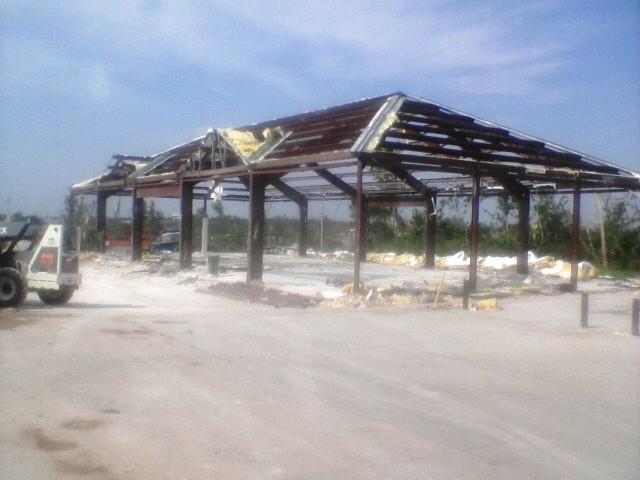
 My first sight of the damage was the remains of a convenience store that had been stripped to the steel framework.  I had seen hurricane damage from Katrina, Rita and Ike, but nothing like this before.    And there was more to come.

 Driving through the residential area I saw many homes, garages and other buildings in various states of damage from windows blown out to foundations stripped clean and everything in between.

DAMAGED RESIDENCE


The death toll was reported at 153.  I could believe it.  At best, the residents had 20 minutes warning from the tornado sirens (unless they'd been watching the weather reports).  I read that at St. John's Regional Medical Center it was barely five minutes warning. Five patients died, all from a power failure that shut down their respirators.  Considering that two whole floors were blown away and all the windows lost, that's remarkable with only five minutes warning. Perhaps if the generator had been in the basement as was the case with Phoebe Sumpter Regional Hospital, it would have been better.  


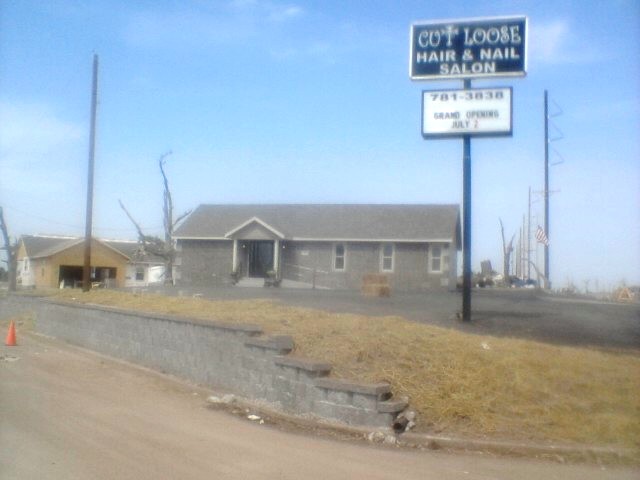
The hospital fared better than most buildings directly in the tornado's path.  Homes, businesses, schools and churches alike suffered from the storm.   It's destructive force was applied equally in all cases.  However, some recovered better than others.  I came across a humble nail salon that had been completely rebuilt in the six weeks since the storm and was open again for business.  Amazing!

One lesson I learned from examining the pattern of destruction is that there were only two safe places when a the tornado strikes: elsewhere and below ground level.  I think when I have a place of my own it will include an underground tornado shelter.

WORK CREW REMOVING DEBRIS
A month and a half later the signs of recovery were quite apparent.  Streets, sidewalks and parking areas were clear of debris.  Power and communications are mostly restored and traffic lights are working again so traiffic is flowing smoothly through the area.  Work crews are all around, even on a Sunday morning, demolishing ruined buildings and hauling away debris.

FLAG DISPLAY - US AND US ARMY RETIRED
The signs of recovery are good as is the spirit of the community.  Volunteers are frequently seen, especially at the local, undamaged churches. Signs are everywhere advertizing firms to remove debris, rebuild and rent or sell homes to the displaced.  The construction firms are especially active; for one representative even stopped me and offered his services.  I had to point to my Texas license plate and explain that I was just passing through.  It seems there's plenty of work here for quite awhile. On numerous lots various flags were displayed to reassure the public that faith in God and America is still strong here too.

DESTROYED STRIP MALL


It's an ill wind that blows no one any good.  It's a clear tragedy for those who died or suffered loss.  God only knows how that will be resolved.  The insurance companies and the taxpayers are surely suffering too.   However, it means work for many, renewal for the damaged districts and a huge opportunity for the scrap metal business.

TRUCKLOAD OF STUMPS BEING REMOVED
I also wondered what will be done with many tons of scrap wood being removed.  It would be tragic if it were landfilled.  It could be recycled into gas, charcoal and potash, all valuable for energy and agriculture.  I hope some thoughtful official or engineer will arrange for such a project.

In an interesting twist, the Home Depot hardware store was destroyed in the storm and had resumed business under a tent.  It is appropriate that such a store would be among the first to rebuild and will surely do well in the rebuilding cycle.  I also noted that the Lowes hardware store was undamaged and also doing steady business.  I can't say for sure if there's a correspondence, but I do imagine that former chain's support for homosexual activism could have brought divine wrath closer to home and spared their competitor.

LOWE'S RESUMES BUSINESS IN TENT


HOUSE FOR SALE - JOPLIN MO


Saturday, June 25, 2011

MATAGORDA BEACH


School is out and summer has begun.  It was nearly time to leave for summer camp and a busy summer schedule.  My daughter was concerned we wouldn’t have time to go to the beach this year if we didn’t go soon.  I liked the idea, so I looked into the possibilities.  When we lived in central Texas it was feasible to drive by car to some nice beaches in Port Aransas or Padre Island.  Now that we live in East Texas it’s much too far to go there and have time left to enjoy a full day or two at the beach.  The nearest popular coastal beach is Galveston.

Add caption
Galveston is convenient and has nice facilities and restaurants and plenty of decent hotels.  However, it’s close proximity to Houston means the beaches are quite crowded when the weather is tolerable.  We like Port Aransas, Mustang Island and Padre Island because the facilities there are as good or better than Galveston and the beaches and water are cleaner and there is less Sargassum on the beaches.  However, now it’s a full day just to drive there. 

There’s a reasonable compromise between these that I am somewhat reluctant to advertise.  That is Matagorda Beach.  Near Matagorda, TX is the Matagorda Bay RV Park.  It’s a small but well designed and maintained park that borders on the coast and includes the mouth of the Colorado River.  The part has a full-time staffed office, a nature center, bath house, RV parking and a beach side picnic area with showers and changing rooms.  For me, it’s main attraction is that it is off the beaten track and only lightly populated with tourists.  The beaches are comparable to Galveston and the water is also murky compared to Port Aransas and points south. The town of Matagorda offers few conveniences beyond a smattering of small restaurants, hotels, shoreline cottages and a supermarket.  They do rate a post office though and have a high per-capita of churches.
View from Intracoastal Waterway Bridge


We drove there from our home in East Texas and arrived late in the morning in the proclaimed “Birding Capital of North America” with over 230 species of birds observed in the area.  My daughter wanted to park on the beach so we had to backtrack to a nearby fish camp to buy the $10 beach parking permit.  Boldly lettered signs at the entrance to the county beach warn visitors that the fine for parking on the beach sans permit ranges from $50-$500.  I presume the range allows for the variations in attitude of those caught parking without permit.  The signs also warn that there is no towing allowed.  I should have paid more attention to this part as I drove slowly down the graded lane on the beach looking for an uncrowded parking spot.

THE CATCH OF THE DAY
The sun was bright, but a partly cloudy sky and a steady on-shore breeze kept things tolerable for the first few hours.  My daughter fished, collected shells, swam and built a small sand castle while I swam and walked up and down the beach.  It was a nice morning.

Around noon it began to get hot and we were getting a little pink so we decided to head in for lunch to escape the hottest and brightest part of the day.  As we started to put out, I heard a familiar and unwelcome sound.  It was a rear wheel spinning futilely in the soft sand.  Unperturbed, I tried all the standard strategies such as rocking back and forth, creeping forward slowly and even soliciting passerby to help push.  I even tried putting seaweed and other flotsam such as a sneaker and some boards under the tires. None of these things worked and the car sank until it’s undercarriage rested comfortably on the damp sand and sargassum. (Note: do not use sneakers for traction.  They melt.)

Some youth in a maroon pickup passed by and laughed derisively without offering any assistance. Sigh! God bless them with more compassion.

Providentially, I found some lengthy 2x6 boards.  Using the shortest as a base, I jacked the car off the sand and dug a shallow trench under each rear tire.  Into the trench I put the other two boards to make a solid surface on which to drive.  Then I lowered the car and stowed the jack back in the trunk.  
STUCK IN THE SAND

All this took more than an hour while we slowly baked in the increasingly intense sun.  Something about being a teenager kept my daughter from seeking shade or using sunscreen to protect her fair skin.

About the time I stowed the jack, another pickup arrived and the two local men in it offered to tow the car out with a handy tow strap they carried.  Remembering the legal prohibition of towing and eager to test my engineering skills, I politely declined and attempted t drive the car out of its sandy resting place without assistance.
A LITTLE IMPROMPTU ENGINEERING
In the driver seat I said a brief prayer, engaged the transmission and slowly depressed the accelerator.  The right rear tire squealed a bit as it fought for traction, but the car slowly advanced and rose out of the sand.  Delighted, I drove onto the graded lane and did a slow and graceful turn about. I waved triumphantly to the kind family that had helped push earlier, blessed the locals with the pickup truck and picked up my sunburnt daughter on the way to the exit.

VIEW FROM RIVERBEND ACROSS RIVER
For dinner we went to the Riverbend Restaurant and Tavern. The menu was a bit sparse and the food ordinary but edible.  The main attraction was a clearing across the Colorado river where we could watch wildlife such as peccaries come out to feed in the late afternoon.  The restaurant staff provides binoculars so the diners can see better.
 
After our dinner we went back to the hotel for a rest.  My dear child was exhausted from watching me extract the car and in pain from her sunburn.  I left her to rest and reflect on the wisdom of acting on parental advice and took a solo driving tour of the nearby town.

Matagorda is small, and the tour lasted less than half an hour.  The primary occupation of the inhabitants after retail, restaurants, hotels and rental cabins appears to be boat storage rental and government work.  There were a large number of churches and little entertainment. Matagorda is the third oldest city in Texas, founded in 1827, but most buildings date after the Great September Hurricane of 1854 which leveled a majority of the town.  It was hit hard again in 1941 with nearly 11’ tides.
St. Peters Baptist Church

Matagorda even has a connection to the Texas War for Independence.  It is the final resting place of Samuel Rhoads Fisher, 1794-1839, signer of Texas Declaration of Independence and Republic of Texas Secretary of the Navy.  Originally from Pennsylvania, he died there as a result of a shooting.  His heirs deeded land on which St. Peter’s Baptist Church was built.  That’s what I know of Matagorda history so far.

HISTORICAL MARKER AT ST. PETERS

After the tour, I too was tired and turned in for the night.

NATURAL SCIENCE CENTER

In the morning we went to the Natural Science Center at Matagorda State Park.   It was a nicely appointed facility with very friendly staff.  The attendant gave us a personal tour or the center and let us feed the live turtles kept in aquariums there. The center has a nice collection of hands-on displays and learning activities as well as classrooms and a small souvenir shop.  As we were leaving, two women arrived with a carload or caged bids for a traveling lecture.  I helped carry some in and had a close up view of fine specimens of great horned owl and barn owl. 

After visiting the science center, we returned to the beach for a last visit, understandably short.  While there I noted three other visitors being towed out of the sand by considerate locals.  That helped me feel better about my adventures the day before. 

Satisfied with our beach trip, we packed up and headed home.  I think we shall return again with sunscreen and a four wheel drive vehicle.