Friday, January 7, 2011

IN MEMORIAM - BABY BEAR

After the death of Ivy we had a small hope that Cupcake would take her place.  But that dog was a useless as it was large.  In fact, she had a taste for quail.  After demolishing their cage, she ate what quail she could catch. (Those that escaped lived in among the purple hulled peas nearby until predators wiped them out.) She barked and cried all night and had a dangerous look in her eye when she regarded our dearly beloved cat, Tabby.  I would have exiled her immediately, but my youngest daughter had already established her dog rescue compound in our back yard and we were committed to raising the nine puppies remaining.

So, in about the space of a week, I'd gone from losing the one dog I owned to having ten of them.  In the next Sunday School class I related the story briefly and assured my classmates they could put a hold on their prayers regarding any more dogs for us for some time to come.

We raised the puppies until they were eating solid food and then began finding homes for them.  I had a fondness for tan one that was similar in color to Ivy and my daughter selected a black one with white forepaws that was particularly fuzzy - like a bear cub.  Hence we acquired Goldy and Baby Bear, but not quite.

In late December we had found homes for Cupcake and all but three of her puppies.  There remained Goldy, Baby Bear and a puppy we named Oreo because she was black with a white belly.  I intended to find a home for Oreo, but a suitable owner hadn't appeared at that time. Then tragedy struck, not once but thrice.  

In later December a freak tornado ripped through the next-door neighbor's yard and tore off half the roof of their house while they sheltered in the windowless pantry. Thankfully no one was hurt thought their house and my barn were totaled. We were spared a direct hit, but the strong winds also decapitated a small, newly built barn I'd made and shifted the remainder off it's foundation since I hadn't had opportunity to secure it yet.  The shed's corner struck Goldy who had been sheltering in its lee during the storm and pinned her by her forelegs in the mud.

I'd been downtown and sheltered at the public library when the tornado sirens blared.  Shortly after that I came home to see what the damage was.  The fence was down around the barn, and the horse, Sassy, and sheep, Stinky, were loose.  Fragments of building were everywhere on what resembled a battlefield.  Twisted metal and large splinters of wood were impaled all around the path of the tornado and debris were littered everywhere around on the rain soaked ground.  Glumly I noted that our trampoline had gone aloft and not returned to earth intact, but brightened to see that the house was only missing some shingles and glass.

Baby Bear was unhurt and greeted me in a subdued mood in the back yard.  I heard some whimpering and didn't see either Goldy or Oreo immediately.  I followed the sound of whimpering and found Goldy with only her head and hindquarters sticking out from under the corner of the barn where it had been driven into the mud by the storm.  I felt sympathetic pain and horror as I imagined what awful injuries the mud and twisted lumber must conceal.  I briefly debated taking a gun and ending her misery, but decided to investigate more thoroughly.

Inside the ruined shed I saw Goldy's small paws protruding from under the baseboard of the barn's frame and knelt to feel them... They were still warm and they wiggled when I touched them.  That gave me some initial hope and I began carefully digging around them with my hands.  Outside Goldy whimpered quietly as Baby Bear watched silently from the tilted and twisted doorway.  The rain soaked hay above me in the loft dribbled water on my head and back as I worked. in the cold drizzle  Oreo came in from somewhere and watched my progress silently.

The mud piled up between my legs as I dug and gradually both of Goldy's forelegs appeared.  Feeling them, I discovered they were whole, and my hopes rose.  Soon I cleared all the dirt from around them.  Then I moved back outside and after comforting the pinned dog, began digging with my hands around her shoulders and torso.  It was cold, messy, wet work, but after about twenty minutes I freed her and pulled the puppy out from under the shed.  She stopped whimpering and licked my face.  I looked her over carefully and thankfully found no cuts and felt no broken bones.  I was very happy and relieved.  Setting her on her feet, I let her try to walk.  She limped painfully, but could move about.  I assumed she'd recover, but took her to the veterinarian just to be sure.

Dr. Kennington x-rayed and examined the puppy and discovered only a fracture in one leg.  I was about to take her home when a vet tech approached me, having heard previously I had been giving away puppies.  He wanted her as a gift for his girlfriend.  I had planned to keep her for myself, but we already had two other dogs.  I suggested he could have her if he paid the vet bill, but he explained he had no money.  So I paid the bill myself and gave her to him as a gift  Another customer was watching this and remarked that he too would have wanted that puppy - it was a fine looking dog.  So, empty handed and lighter in the wallet (our insurance didn't cover animals) I returned home.

Back at home my daughter and a State Trooper met me and explained that a teenage driver had run their car into our escaped horse.  I helped him pull her from the roadside ditch where she stood frightened and confused and we temporarily shut her up in the topless, tilted barn until another, equine, vet could come to us. The horse recovered, but was permanently injured in her hind leg and later lost her foal.  The driver never apologized and tried to sue us for the damages to her dad’s car she had been speeding by in.  However, we live in a free range area , so it was clearly her fault. Still this meant another three digit vet bill on top of being unemployed and wracked by a tornado.  It wasn't my best day.

But, we still had Baby Bear, Oreo and Tabby the cat.  We had reason to be happy.

The dogs were only pups, but they did try to guard the poultry, if only for their own purposes.  For earlier they and their siblings had broken en-mass into the turkey pen and killed the few that had survived all the other challenges.  So, I knew what sort of temperament they possessed.  They also seemed to understand their role as guards of the barnyard, though they seemed OK with supplementing their kibble rations with an occasional egg or chicken. Despite all this, we still had a few chickens left and these attracted the coyote.

For several nights the coyote would circle around our place at night, hoping for an opening to snatch a chicken.  I never saw it, but would rush out at night when the dogs would bark, rifle and flashlight at the ready.  But the beast always disappeared into the darkness before I could catch sight of it.  I tried setting out a tape player with coyote calls and bait, but it wasn't fooled by these.  After spending several cold nights perched in the cold, windy loft of the barn I gave up trying to catch it that way.

Then one night I heard the puppies barking furiously and the coyote snarling.  I dashed outside with my rifle to see Baby Bear barking and running anxiously around the yard.  Then she lead me in the darkness to the neighbor’s field where I discovered Oreo laying injured in the recently plowed dirt.  Blood was on her side and she was crying.  I brought her into the light where I discovered the coyote had bitten her around her chest and punctured a lung.  It made me angry to think how our landlord wouldn't let dogs in the house and the barn was ruined.  So we had no safe place for the dogs.  We made Oreo as comfortable as we could in a box with a  baby blanket and then took her to the emergency veterinarian clinic.

The veterinarian there examined Oreo and announced she could probably save her, but the surgery would cost $900, cash, in advance.  We didn't have that kind of money and they wouldn't arrange credit.  So sadly, we had to say our goodbyes and let them put Oreo down with an injection rather than let her bleed slowly to death. My daughter was too distressed to watch.  Though it grieved me too, I held Oreo in my hands until it was over. To their credit, they didn't charge us for that and even offered to dispose of the body for us.  I couldn’t imagine treating the brave puppy like a sack of trash.  So I wrapped her in the bloody blanket and we buried her  next to Ivy in the east garden the following day in a little wooden box I made.

That left us with Baby Bear and she soon grew happy, healthy and big enough to hold her own with the coyotes.

Then along came Goldilocks.

My daughter had a friend from school that had a golden retriever puppy they couldn't manage.  I agreed to look at the dog and her dad brought the puppy over. It was a beautiful, loving female golden retriever about the same age as Baby Bear.  They immediately got along well and she showed real interest in us too.  It turned out that the owner was a former colleague of mine from a manufacturing company in town where we'd both worked about 15 years ago.  We were glad to meet again and shared news while the girls introduced the dogs.  When it was all said and done it was a done deal.  Goldilocks had a new home and Baby Bear had a step sister.  They became inseparable friends.  I knew I’d made a good decision when a passerby offered to buy Goldilocks from me for a good sum, explaining how scarce but popular they were in these parts.

The two dogs played endlessly together day after day as spring turned into summer.  They grew large, strong and healthy and were ideal as outside dogs.  Together they exercised and entertained each other and kept the varmints at bay and we didn't have another loss to the wildlife from the poultry. 

Baby Bear was my daughter's favorite as Goldilocks was mine.  When she was still fairly small, Baby Bear would travel with my daughter for visitation with my ex-wife. Goldylocks stayed home and guarded the flocks or visited overnight with a friend’s dogs. Eventually Baby Bear was too big for her apartment, and she stayed home those weekends.
About that time Baby Bear and Goldy were getting old enough to go into heat.  Male dogs came about checking out the opportunities.  So with a good friend’s encouragement and financial support we decided to spay Baby Bear over my younger daughter’s objections.  There’s a supposedly low-cost spay-neuter clinic in town where we took her.  The bill was much higher than advertised and the scar was larger and sloppier than we would have liked.  I didn’t spay Goldilocksfor I had plans to breed her later, but BB was only a mutt and proved to have some undesirable qualities.

That's when the big trouble started.

We came home one weekend, a chicken was missing and there was a pile of feathers that looked familiar on the lawn.  I suspected Baby Bear because she'd been involved in the disappearance of some turkey poults earlier, but my daughter was adamant about her dog's innocence.  She insisted it had been a coyote, but I found no tracks or other traces of varmints around the house or fields.

Two weeks later we came home again to find two more chickens missing and two more piles of feather.  Again I suspected Baby Bear, but there was no hard evidence.  On the next trip I left her with a friend for the weekend and left Goldy in charge.  No chickens vanished so I felt I'd identified the problem.  I couldn't see boarding Baby Bear every time we left town, so I stated building a dog pen.  I had no spare money, but I had about forty feet of chain link fence and some lumber.  This was enough, but required some time and labor.

Baby Bear must have known what was coming for more than once I saw her chasing a chicken around the yard.  She was getting her licks in while the getting was good.   She also began chasing Tabby, and a neighbor complained about a missing cat and had i.d.'d a black dog with a purple collar,.

Then we came home another time and found Goldilocks chowing down on one of our best egg producers.  I scolded her and tied her up for a week in isolation as punishment.  We never actually saw her kill a chicken, though she I suspect she was glad enough to eat Baby Bear’s kills. We had to do the same with Baby Bear twice after that while I worked on building the pen with help from a friend's son.  Baby Bear didn’t like being isolated, but she seemed to understand what it was about.

Meanwhile, Baby Bear was otherwise a wonderful, loving dog.  She and Goldy learned tricks together such as leaping over a fence, shaking hands, sitting on command & etc. In fact, she excelled at jumping and would leap up on the new trampoline where Goldy couldn’t reach and tease her step-sister from her secure perch. As I worked in the yard she would come and push her head under my arm to be petted.  Often she would roll on her back to present her tummy to be rubbed - a favorite custom.  If my face was down at her level, she would try to lick me on the face, her way of giving kisses.  It amazed me that the same muzzle could be so gentle and kind to me and tear another living creature to small gory bits.

Finally, the weekend before Christmas, the pen was done except I had no latch for the gate, finances being what they were.  We had to leave that afternoon so I went to catch Baby Bear to put her in it.  I added a doghouse I’d built earlier and put hay and a large stuffed bear inside to make it cozy.  A bulk feeder and bucket of water made it complete, but Baby Bear wouldn't have it - she ran off.  We were running late for our bi-weekly trip, so I told my daughter to catch Baby Bear, put her in the pen and securely tie the gate with rope before we left.

I was in visiting a friend the next day when I received the fateful call.

A neighbor, the Sunday School teacher from the local church, had found Baby Bear dead in the road.  Doing a great kindness for us, he took her out of the road and buried her behind the barn  From what I gathered, she'd worked the rope loose and escaped.  It happened the same day we left, so she hadn't taken long to escape or be killed.  No one claimed to have done or seen the vile deed.  I didn't tell my daughter until she returned.

When I returned home and went back to the pen I found the stuffed bear shredded and the rope unraveled.  Baby Bear had not liked being confined.  I could understand that, since she roamed free most of the time.  But she'd paid the ultimate price for that afternoon of freedom.

The neighbor had accidentally buried her off of our property in the next door neighbor’s pea patch, which was due to be plowed up soon.  That didn't seem like a good place to leave her.  So I made a coffin and reburied her on the other side of Ivy in the east garden.  It was not a pleasant task! I made a small metal plaque that read:

Baby Bear
2009-2010

and buried her with a bone, a toy, some words and a prayer thanking God for her life and hoping for no more losses.  Goldilocks watched all this in solemn silence.  She sniffed at her step-sister’s still frame and later at the coffin as I buried it.  She seemed to understand what was happening, but also seemed on edge, even afraid and wouldn’t come close.  Goldilocks clearly missed her companion, was less playful than before and more desperate for reassuring attention.  She tried to engage Stinky the sheep in the games she’d played before with Baby Bear, but it wasn’t the same.

As we rode home after the New Year, I broke the news to my daughter.  She was sad and thoughtful, but it cheered her up to think we’d go looking for another puppy to take Baby Bear’s place and she promised to try to be more protective of the next one. In the end, Baby Bear was generally a good dog, not the best, but we loved her and miss her.

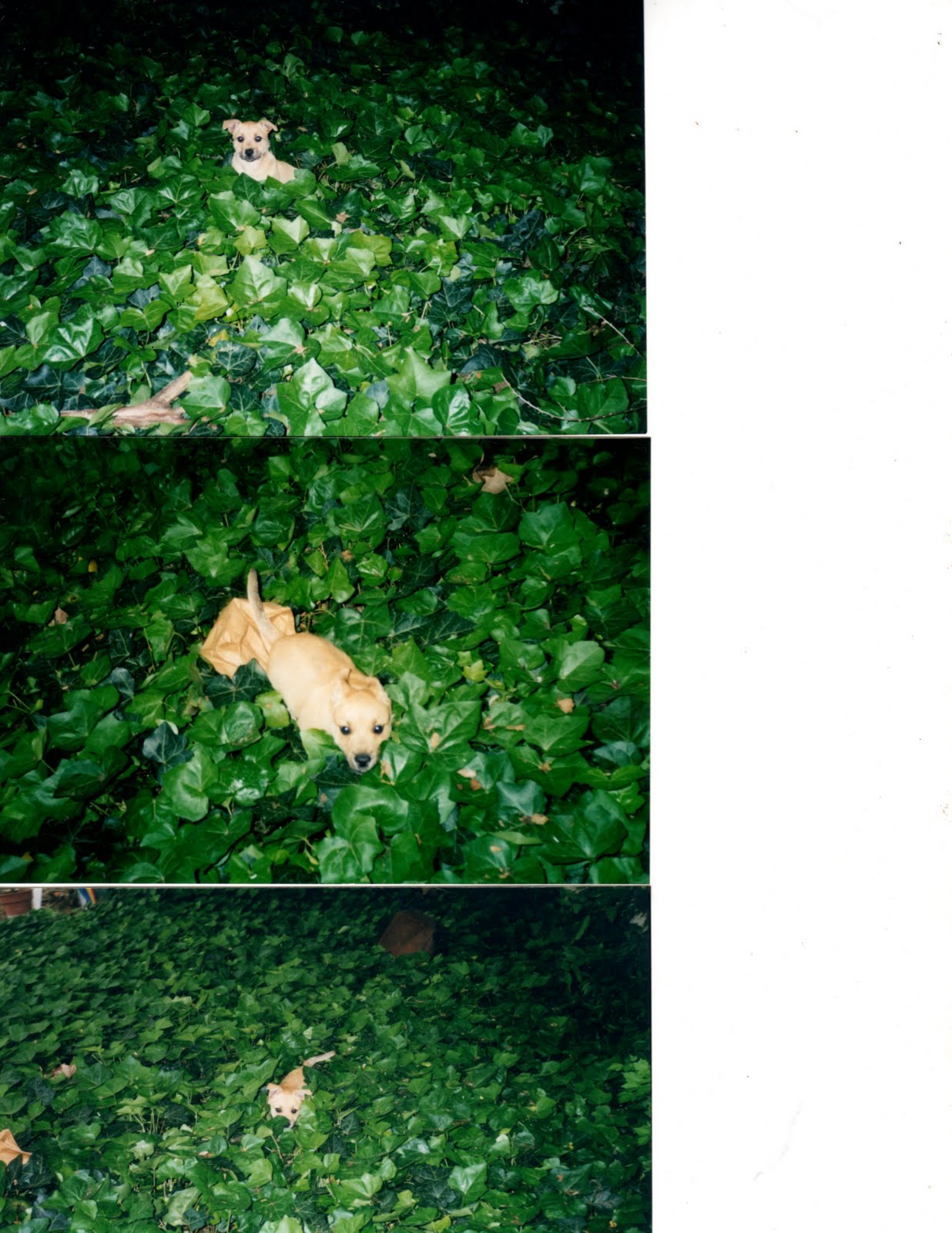

IN MEMORIAM - IVY THE ROCKET DOG

Back in the spring of 2002 I was enduring one of the lowest and most arduous times of my life.  My employer included me in a massive layoff, our family was disintegrating and my small publishing business was failing.  I really needed something positive in my life.  To keep my spirits up I would go for a jog around the neighborhood, and one afternoon I encountered something new when I detoured from my usual circuit.
A small mixed breed puppy met me in the middle of the block and I stopped to look at her.  She was a fuzzy, light brown pup about three weeks old, looked like a Terrier, but seemed rather large for the breed. We liked each other on sight and I continued my jog at a slow pace to see if she'd follow me.
Sure enough, the pup scampered along, keeping up with me quite well.  As we ran together I considered keeping her.  I had not owned a dog since 1997 when we moved to the neighborhood and my soon to be ex-wife stridently insisted we didn't have space for our dog Tarcza and forced me to find her another home. As I had since separated from that wife, the possibility for another dog was open and appealing.  I mulled these things over as we headed towards the house.
When we arrived I realized there was a formality to observe.  I needed to ask permission of the head of the household to keep the puppy.  With a wry smile I asked myself, "Please, may I keep the puppy?  She's adorable and loves me! And it followed me home."  I regarded myself with another wry smile and answered, "Yes, but on the condition that you take proper care of her."
It was a done deal in less time than it takes to write about it.
My daughters immediately loved her too, although there was the issue of position in the pack to establish.  The puppy, though small, was of the dominant personality and immediately set about trying to put the girls in their place.  A few nips and barks later she discovered that she was firmly at the bottom, just below the cats.
There were the usual issues of housebreaking, learning to walk on a leash (I dislike leashes but our city had leash laws) and learning tricks.  Remarkably, we had few problems with chewing or late night barking.  The final matter was to give the dog a name.
From the start, the puppy loved to explore and play.  And very soon she discovered the particularly canine joys of sleeping, hunting and hiding in the thick patch of english ivy next to the back porch.  Seeing her love for this plant, we dubbed her "Ivy."  All agreed it was a fitting name and ever after she was affectionately called Ivy.  Now, I don't subscribe to the common practice of giving a pet the family name.  I believe you need to be properly in the family tree by birth or legal adoption to have that honor.  In short, the family is all of the same species, though pets are welcome as household members, just not accorded all the rights and privileges as family, especially eating at the table.

As a puppy, Ivy loved to hide and sleep in a patch of ivy behind our house.

Anyway, Ivy still needed some appellation to her forename.  That became obvious as she grew and joined me on my runs around the neighborhood.  Ivy loved to run.  If her collar choked her when she pulled on the leash she showed no sign of it and would charge forward and run as hard and fast as she could before me.  It was great exercise for me.  My leisurely jogs turned into intense runs up and down hill, zipping along the sidewalks and roadways as long as my stamina held out.  Ivy never tired before me unless we went by bicycle instead.  Only then could I outlast her.
So, her official full name became "Ivy the Rocket Dog," for her love of speed.
That didn't mean she liked riding in the car - at least not at first.  For about the first year, Ivy became quite carsick even on short trips.  I was glad when that mini van she first rode in breathed its last and we could finally get a fresh car.  By then Ivy had her "car legs" and didn't become ill anymore.  For it wasn't possible to completely clean the carpeting in the vehicle from all traces of her accidents.  After that, she loved to travel.  She would happily jump in the car at the merest excuse for a trip.  Eventually she traveled much of the Midwest with me.  We went as far north as Nebraska and as far east a Kentucky.  And she loved it all.
Ivy was a good mother.  Before she had pups of her own, we raised some chicks the spring after we brought her into the home.  She loved the little birds and would gently herd them about like a mother hen with her nose.  She even slept with them to keep them warm.  Ivy also looked after the children, guarding them as they played in the yard and even scolding them when she though them too boisterous. Later she had two litters of her own before we had her spayed.  They were fine little pups, apparently from the same mixed breed father whom we never meet.  I found homes for all of these, some in our neighborhood.  We visited her progeny a few times and Ivy always was happy to see them and those I was able to check on did well.
During Ivy's time with us I had to work out of town a couple of times.  First was in Houston where I had a wonderful landlady named Sally.  Sally had another boarder with two dogs already so Ivy fit right in.  Ivy was a good influence on those dogs too, since they had hitherto refused to learn to be housebroken.  Ivy set the example and gradually the pack improved their manners.  In gratitude for her hospitality and understanding, I installed a dog door for Sally who was delighted at not having to constantly let the pack in and out of the house.  Later when I had to move to an apartment which didn't allow dogs, Sally took in Ivy for a couple years.  At first she was reluctant to take on the responsibility, but they were fast friends and Ivy not only gave much comfort, but helped with security since the neighborhood was a little on the dangerous side.
And Ivy was very brave.  I never saw her back down from another dog, no matter how large or fierce.  More than once I was out for a walk with her and some huge canine was roaming about and charged us fiercely barking with jaws snapping.  Ivy would plant herself firmly in its path and give back the same until the other dog backed off.  I never saw her actually fight, but I'm sure she would have not retreated. She also loved to chase cats - not catch them, just chase them.  She was raised with two tabbies and so learned not to do cats any harm.  But she couldn't resist chasing them and any loose cat was fair game.  She would tear after them as if determined to catch and kill them, but was always sporting enough to give them sufficient lead to escape, though often quite narrowly.  It gave her much pleasure and since it kept the cats fit and alert while doing no real harm, I didn't interfere as long as it was fair and reasonable.
One of Ivy's great adventures was accompanying me to Louisville, KY where I worked for part of 2007.  I had a little efficiency apartment there with a small back yard.  It was cramped compared with her previous homes, but she adjusted well.  Since the weather was cold there that winter, she preferred to be inside.  Initially I didn’t know my fellow boarders well and there was no dog-door, so she had to wait all day for me to return from work.  Though as an engineer I often had to work long hours, she was very good about not making a mess and waited faithfully for me to come home.  It was also a tough neighborhood, and it is likely she kept the riffraff away since I never had any trouble though some of my neighbors did.
The highlight of our stay in Louisville for Ivy was snow.  She saw her first real snowfall there and thoroughly loved it.  It was a heavy snowfall too.  It shut down the city that night and turned by typically 40 minute commute back home from work into an 11 hour ordeal.  Thankfully by then I had made a trusted friend who would let her out when I was late and she happily frolicked in the new fallen snow when he let her out.
After Louisville, we moved to East Texas where Ivy found paradise.  We rented a little house on an acre with fifteen more acres around us.  It is a free range portion of the county, so Ivy was finally free of fences and chains and could roam about happily with no limitations. Again we bought some poultry and Ivy diligently guarded them day and night from the many varmints that were common in the area.  One of the most notorious was a skunk that was like responsible for the disappearance of two geese, three ducks, six quail and about half a dozen chickens on the occasions when we had to be away with Ivy.  It lived in an impenetrable brush pile in our neighbor's field and eluded capture for months.
Finally Ivy and I cut it off during one of its forays and flushed it into the open field where Ivy tore it to pieces.  It was the fattest skunk I had ever seen.  The poultry losses stopped abruptly until tragedy struck a couple months later.  Later the neighbor removed the brush pile and we were much happier.
At about that time we also adopted temporarily a pregnant stray dog the neighborhood children euphemistically named "Cupcake."  This dog had nothing to endear it to me, and only my adolescent daughter’s strident and persistent pleas moved me to take it in until its puppies were born.  Ivy had her reservations about Cupcake, but kept peace with her out of professional courtesy.

It was early October when this was happening.  On the ninth I came home from work to find Ivy lying dead in the ditch before our house.  I was shocked, stunned and deeply grieved.  She had no visible injuries, but had plainly been struck by some yahoo speeding on the road in front of our house.  I knelt by her mortal remains and gathered her up in my arms ,carried her to the shed in the back yard and laid her where she would be undisturbed. Numbly I gathered my tools and some woods scraps.  I could not discard this dear friend without ceremony and using the stoutest pierces of oak I had began to build her a small coffin.
In the following Sunday School class I shared my grief over Ivy's death and asked my classmates to pray for a dog to take Ivy's place to guard our flocks.  That night both rain and bitter cold came, followed by the birth of Cupcake's ten puppies.  Most of the litter did well, but despite our care and shelter, one didn't make it.  (We suspect that Cupcake, not the best mother, accidentally smothered it.) So, I finished the coffin the next morning and laid both Ivy and the lost pup together.  I shrouded her with an old towel, added a well chewed bone and a favorite toy, and then dug a grave in the east flower bed.
My daughter and I laid Ivy to rest with a simple ceremony of memories recalled and a prayer thanking God for her love and courage.  It was difficult shoveling the cold earth into the grave as I said goodbye to Ivy for the last time.  Later, my daughter brought out a candle in a jar and lit it.  The tiny light said more eloquently than words that her memory and spirit still live.  One tiny, fluffy puppy, it’s eyes still closed, would soon join our household as the next canine member, though briefly.  That’s the story of Goldilocks and Baby Bear.

Monday, December 27, 2010

THE LITTLE THINGS - HOMEMADE CHRISTMAS PRESENTS

In general, my family are working professionals and materially well off.  Some years ago we all agreed that we typically had the material posessions we really needed and exchanging gifts at Christmas should be more a matter of the spirit than the object.  What we agreed to do, was take turns each year designating our favorite charity.  We would all donate to that charity in the name of the selected person.  For example, one year we bought an entire heifer for a family in Africa and another a flock of poultry for another family on Poland. Thus we were able to make some substantial gifts to persons and projects that were truly needy.  To keep things personal, we still exchanged small tokens of our affection, often handmade or of special sentimental value.


Although my material circumstances are rather limited this year, I donated to the charity - a bicycle repairing non-profit my brother founded and also produced some interesting presents of three kinds.

BREAD
We had plenty of flour  etc., so first I baked some of my favorite bread, the Rosemary French Bread described earlier.  That was an easy choice.  Then I looked around to see what other resources I had to make gifts of.


ROSEMARIE.


We had a large bush of it in the front yard, and another at my sister's house and both badly needed pruning.  I trimmed them up nice and neatly and saved the clippings.in the loft of the shed where they could dry undisturbed.  First I tackled the smaller batch from the front yard.  Over two evenings I stripped the healthy looking leaves off the branches onto some newspaper.  The leaves were then washed in our salad spinner and spread out on newprint to dry. I noticed that those stripped the first evening while the branches were still fresh looked darker and fuller when dried. This may be good to remember if we do this again. It was actually pleasant work and the kitchen where I worked soon filled with the fragrance of rosemarie.


Later I dried and stripped the larger batch from my sister's house.  It alone was nearly a trunkful of branches and looked quite daunting after spending two evenings on less than half that quantity before.  But on the first batch I had developed a system for separating and stripping the leaves that went quite quickly.  The method is to take the larger, bushier branches and break them apart into smaller clusters of one to four twigs.  Then firmly grip the base of the branch in one hand, and slide the other from base to tip briskly several times, depositing each handful of leaves on the newsprint before me.  I removed dead branches and other matter before stripping the leaves and didn't try to strip off color sections and very strongly attached leaves. In a couple of hours I had stripped about four pounds of dried leaves.  


After rinsing the dried leaves about five or six times in cold water and spin drying them, I spread them to dry overnight on newsprint in a slight breeze.  They didn't absorb much moisture, but did color the water a faint green.  I wondered if they were losing flavor or essential oils during this step, but felt it was important to remove the dirt they had accumulated growing outside.  All told, I harvested about two pounds of dried rosemarie leaves from the front yard and four from my sister's bush.


Once dry, I had to grind them.  I tried grinding by mashing with a spoon in a bowl or rubbing between my hands, but both proved too laborious for such a large quantity.  I relented and ordered a coffee grinder, about $11.  (True to life, I saw a new one a few days later in a resale shop for $2, and bought it also as a gift for someone who was also interested in this - good to ahve a backup.)    Anyway, I had to pulverize the leaves in handfuls in the electric grinder, but it did a good job.  The ground leaves were a little irregular in size, so they had to be sifted and the large pieces reground.


In the end I wound up with about six pounds of high quality spice, a portion if which I kept for myself and the balance I gave away as gifts.  These were much apprecaited given the personal nature of the source and the high retail cost of good spice!


Looking around, I saw another resource for gifts:


SCRAP METAL


Namely I had a fair supply of scrap lead, copper, brass and aluminum that I could smelt.  There was steel also, but I didn't have the means to melt and cast it.  (Steel melts at about 2300 deg. F.) For earlier this year I had built a small smelter from a design I saw in the Internet.  It was simply a blower that forced air into a coffee can filled with charcoal.  A stainless steel camping mug served as the crucible (the ordinary steel can I tried initially was too thin and burned through when it reacted with the molten aluminum).


I gather the scrap metal to supplement the inadequate income from UI.  Either donated by neighbors and friends glad to have me help clean up their property or found abandoned on the local roads, it adds up.  In steel alone, I collect about 250-500 lbs a month which basically covers the water utility and an occasional treat.  Aluminum weighs in about about 50 lbs a week and pays for gas for the car.  I find the other metals in small bits here and there, but over the course of the past year I picked up about 50 lbs or each kind. 


For my first project, I cast a small lead grave marker for Ivy's plot in the garden.  It turned out pretty well when cast in a plaster mold I made, but I learned that the mold must be perfectly dry before casting.  Otherwise, steam from the moisture remaining in the plaster leaves small depressions in the hardened metal.


Lead - melting point: 327.5 °C (600.65 K, 621.5 °F)


Increasing the temperature, I was able to cast a small aluminum cross for a birthday present.


Aluminum - melting point 660.37 °C (933.52 K, 1220.666 °F)


For aluminum I tried sand casting, but had some problems.  The local soil was too fine and crumbly to make greensand. (A mixture of moist sand and clay used in pattern casting.)  I tried sifting sand from the local creek, but it also didn't stick together well and the high iron content in it made it char and fuse to the aluminum.  I did get a couple usable castings, but with only coarse resolution.


Copper - melting point 1083.0 °C (1356.15 K, 1981.4 °F)


Next I decided to attempt casting in copper, and first made a clay model from which to make a wax pattern. I tried a variety of different ways to make a rubber mold for a way pattern from the clay original, none of which were satisfactory.  The RTV compunds commonly found in hardware and automotive stores were too sticky, and the professional impression compound I bought reacted with the oil in the modeling clay and would not cure.  The plaster had to be cast directly on the clay and then broken away from the clay and glued back together. 


Plaster alone is fine for lead, but needs to be fortified with about 1/3 part fine brick dust to take the heat of copper.  The mold should be heated to about 900 deg. F ideally, but 500 is as high as my oven will go.

Thursday, December 23, 2010

THE LITTLE THINGS - LAUNDRY PART I - THE CLOTHELINE

When I worked at Applied Materials a few years back there was a Toastmasters International (TMI) club, Toastmatters, that met there weekly.  I enjoyed these occasions very much and benefited from the practice of speaking and evaluating speeches.  As VP of Education for the club I was called upon to judge a speech contest.  As an engineer, one of the contestant's speeches appealed to me very much. It was on the economic merits of using a clothesline for drying laundry.  Little did I know that this speech would provide the material I needed to solve another of the challenges we faced.

If you've every had to downsize economically, you probably experienced what we did - a steady failure of appliances and automobile components that dealt ringing, near-fatal blows to the budget.  Our dryer was among the first to go.  It still would tumble the laundry, but the door kept popping open because of a faulty latch and the heat was erratic.  I ordered a new door latch and fixed that myself (saving a $50 service call).  But the heating element finally gave out, and besides that, the enamel flaked off the drum and the bare steel left rust stains on the laundry.  End of the line for the dryer.

Looking about for a solution, I recalled how the TM speaker had touted the low cost of setting up a clothesline - essentially some rope and clothespins.  Moreover, it was solar powered; so the energy was free and it was environmentally sound.  The speech was convincing, so I gave it a try.

Initially this worked well, until the tornado hit last year.  Most of the clothes on the line went airborne and were deposited in regions unknown.  "OK," I concluded, "tornadoes aren't common - we can safely continue with the clothesline method."  Thankfully our insurance was up to date and besides, I liked the smell and feel of clothes dried in the open air. My next challenge was the rain - and cold weather.

Texas has a moderate climate and clothes dry fairly well even in midwinter - unless it rains, as it often does in East Texas.  (If you are more familiar with the westerns filmed in arid regions of Texas, that's primarily in the western part of this vast state.)  Rain was an inconvenience and on multiple occasions, I had to bring in the laundry prematurely, or let it enjoy another rise cycle outdoors and wait until later for it to dry.

When cold weather prevailed, I discovered then that if the clothes are left out in the rain and the ambient temperature drops below freezing, the combination of ice and fabric make a fair substitute for military class armor. If folded over the clothesline, the articles are pretty much stuck on the line until the next thaw (unless you want to cut them off and lose some clothesline!).  If only clipped with clothespins, they may be removed with some effort and a certain level of frostbite on the fingertips.  In such cases, I just brought the frozen articles indoors and let them thaw by the water heater - not enough room there for the whole laundry, but enough for the needs of the day.  I also built a folding rack from 2x4s and galvanized wire that could be set up indoors for emergencies and underwear.


When winter passed, we discovered another challenge to having a clothesline - dogs.  We had a pair of young dogs whose purpose was to entertain us and guard the flocks of poultry.  Training them to our purposes took a bit of time though.  And during this period, the dogs not only ate a fair number of the chickens, but entertained themselves with the laundry we set out to dry.

They were in the habit of leaping up and snatching anything that dangled too low.  They would then season the freshly laundered article of clothing with dirt, grass and small bits of leaf meal.  When it was suitable for canine use, they would then curl up on a small heap of clothing on the lawn and snooze blissfully.  Later, the dogs would play a variation of flag football with some particularly delicate and expensive item, rendering it into a widely dispersed mass of confetti.

They had such fun I couldn't be totally angry, but I did hike up the height of the clothesline and used more secure methods of attachment.

I allowed myself to think I'd mastered the art of clothes-drying when I discovered a whole line of clothes had fallen again and been rendered by the dogs both unfit to wear and diligently shredded.  (Thankfully the other birds and beasts were indifferent to clothing.)  Soon after I discovered that cheap clothesline (like the kind typically made in China) lasts about six months in our climate.  Then it rots and separates - conveniently when you are away from home and the yard creatures have lots of time to investigate all the varied and original uses for clothes, towels and linens.  Applying this lesson, I bought only the best virgin nylon cord made in the USA!  I also noted that the cheap wooden clothespins were also decaying in the moisture and heat.  I decided that a future project would be to make some plastic or aluminum ones.

Still, despite the hardships, I estimated that I'd saved about $25/month in electrical costs, and more than covered the inconvenience and occasional loss of a shirt or three.  I had also come to like the fresh, clean smell that comes from drying laundry out doors.  There's something delightful about the scent of East Texas breezes on freshly laundered sheets as I settle down in a newly made bed for the night.

I think I'll scrap the dryer and make a tumbler out if it!

Wednesday, December 22, 2010

THE LITTLE THINGS - BAKING BREAD

Back in 1998 my employment took our family to Europe for several years where I worked as an engineer to set up several manufacturing lines at a new automotive parts factory.  It was a tough assignment, but a wonderful experience.  One of the things I brought back from that was a love for truly well made bread.  The Europeans have a long history of making fine food, but the simple craft of baking bread has been developed to an art form there.  After enjoying the real thing, I could never be truly satisfied with the bread commonly sold here - even the varieties touted as being "European."  The only local exception I know of is a little German style bakery I know of in Kempner, TX. Every time I pass though that area during their business hours I buy several loaves to bring home.

Anyway, I was used to spending the extra few dollars for the quality breads sold at the local supermarkets and bakeries when we were hit with the harsh reality of a tightened budget.  I found myself still desiring a quality loaf of bread with our meals, but unable to justify the absurd prices charged for it.  For example, the good bread costs about $4-$6 per loaf here at the local bakeries compared to under $1 when I traveled in Poland and the Ukraine.

To maintain this small but important quality of life, I took to baking.  I'd been taught to bake as a child by my mother.  She worked full-time as a teacher and felt is good and just for us three children to all pitch in with the housework - including cooking and baking.  During much of my married life, my wife would do all the cooking, so these skills languished for a couple decades.  Single again, I resurrected these skills and developed them to new levels.

Initially my efforts were less than satisfactory.  The loaves of yeast bread turned out dense and shriveled and the soda breads were often coarse and doughy.  Many batches of rolls, doughnuts and the like that I baked could have doubled as armor-piercing rounds for artillery shells or cheap hog feed. I found the recpies in the books were helpful, but left out some mysterious technical details that allowed the publisher to include pictures of perfect, mouth-watering loaves next to recipes that only gave the most basic instructions and often lead to disappointing results. 

Finally, I learned to bake something comparable to the book illustrations and even began experimenting on my own.  Finally I developed a variation on the recipe for French bread that was a surefire success for me every time.  I decided to call if Rosemary French Bread.  The recipe is as follows:

ROSEMARY FRENCH BREAD

Ingredients:

Unbleached white wheat flour - ~1,300g (about 2-1/2 lbs) (NOT SELF-RISING) [~175g/cup]
Salt - 1 teaspoon - 11g
Sugar - 2 table spoons - 20g
Butter - 2 table spoons
Rosemary - dried and ground - 2 tablespoons - 5g
Yeast - 1/2 teaspoon - 1.5g
Water - 2-1/2 cups - 212g
Shortening - to grease baking sheet, as needed
Optional:
Cornmeal - to sprinkle on baking sheet adn prevent loaves from sticking
Whites from 1 egg with pastry brush

Equipment:
1 Large mixing bowl
1 small cup
1 sauce pan
1 electric mixer with beaters
1 set measuring spoons
1 large sppon
1 baking sheet
1 oven - electric, gas or wood (preferably temperature controlled)

1. Heat 1/4 cup water to 40-45 deg Celsius (105-115 deg F) and add to yeast in a small cup and allow time (about 5 minutes) for yeas to dissolve.  Stir gently.
2. Put salt, sugar and butter into a large mixing bowl
3. Bring 1 cup water to boil and pour into mixing bow with salt & etc., stir briskly until the butter melts and all items are combined
4. Add 1 cup cold water to mixture in large mixing bowl to reduce temperature to luke-warm.  Add dissolved yeast from small cup by pouring into large mixing bowl.
5.  Add the rosemary and 2 cups flour to mixing bowl, and stir with mixer on low speed for about 2 minutes and any additional time needed to mix all ingredients thoroughly into a liquid batter.
6. Add 3-1/2 cups of flour to mixing bowl by cupfuls (or partial cupfuls) and mix with a large spoon until a knead able dough forms.  (Kneadable means it can be handled without either sticking to floured hands and breadboard - too much water, and does not fall apart into chunks and flakes when picked up - too much flour.  Add more flour or water to get desired consistency.
7. Set aside about 1/2 cup flour and use this to dust kneading board and hands.
8. Knead bread for about 5-10 minuets, repeatedly folding dough in on itself so that it is thoroughly mixed.  Add small amounts of water and/or flour to keep dough kneadable.
9. Grease a clean cookie sheet (or loaf pan). Optional - sprinkle with corn meal.
10. Next, return the dough ball to the mixing bowl and let rise.  It will rise faster in a warm environment, slower in a cool one. So, for a shorter cycle time, I turn on the stove to preheat for about 8 minutes to make it warm, but not too hot and turn the stove off again.  Then I cover the bowl with a clean towel and let it rise in the oven for several hours.
11. When the dough has risen and filled the mixing bowl, remove it and divide it into three equal lumps, about 550g each.  Form these into oblong loafs and place these side by side on the greased cookie sheet.  Put them back in a warm over (not hot or on) and let them rise again. The loaves may loose shape or stick together.  Gently separate them and reshape them if necessary after they have risen but before baking them.  If they stick together into one huge blob, the baking sheet is probably too small and a larger one is needed.
12. To bake the loaves, remove them from the oven and remove the towel.  Take a sheet of aluminum foil and fold it at a slight angle and place over each loaf.   Heat the over to 425 F and bake until done.  That is about 30 minutes and is apparent when the edges of the loaves near the baking sheet turn a like brown.
13. Turn off the oven, remove the loaves and take off the aluminum foil covers.  Let them cool on the baking skeet or a cooling rack.
14. Store the finished loaves in a breadbox or wrap them in a plastic bag to preserve freshness.

Optional: brush the tops of the loaves before baking with egg whites to give them an attractive glaze.

COST SAVINGS:

Store bought bread: $4/loaf

Ingredient:
Flour - 5 lbs bag = 6 loaves @ $2.00
Salt - 6 teaspoons => 6 loaves @$0.06
Sugar - 12 tablespoons => 6 loaves @ $0.12  [$0.50/lb - 10g/tablespoon => $0.01/tablespoon]
Rosemary - 2 tablespoons => 6 loaves (free from garden)
Water - 8 cups => 6 loaves @$0.01
Energy - 6 loaves @ $0.50

6 loaves for $2.66 => $0.44 / loaf
Labor - about 20 minutes.

Satisfaction - priceless!

This exercise makes me wonder about why the bread in the store is so expensive and what all those profits are used for.  I for one thinbk I can spend the money better and enjoy both the baking and the eating of my own bread!

Thursday, December 9, 2010

OF CHICKENS AND DOGS

My maternal grandfather raised chickens in his retirement, and the passion to raise poultry seems to have been passed on to me.  When we lived in Round Rock, TX, a friend gave a chicken coop to me to house some chicks I’d bought for the children in the spring of 2002.  We’d also acquired a wonderful puppy that same spring; so the birds and dog grew up together.  The dog was named Ivy because of her habit of playing and sleeping in a patch of english ivy adjacent to the back porch of our house.

Mothering came naturally to our mixed breed, shepherd/terrier dog.  She loved children and pretty much any other young creature.  Ivy would gently sniff at the week old chicks and try to herd them with a push of her snout.  At night the dog would fiercely guard the chick from the numerous varmints that would hunt along the stream-fed greenbelt that ran through our backyard.

When we moved from Round Rock to Longview in 2009, Ivy came with us, but the chickens went to live on Brush Creek Ranch with the Ellerbeck family.  We started a new flock at our house near Macedonia.  At first things went well.  We bought all new poultry: newly hatched chickens, geese, ducks, quail and turkeys.  The flock did fairly well in our back yard and was nearly mature enough to begin egg laying when tragedy struck.  Ivy would bark furiously at night as some predator would attempt to catch birds or two.  It would often happen late at night, and I’d rush out of bed, grab my rifle and dash out side, waving a flashlight around.  The varmint would quickly disappear into a pile of brush on the next lot.

We had to go to Austin every other weekend, and I’d usually take Ivy with me.  On such weekends we’d return to discover a bird or two missing.  So, I ended up having to leave the dog on guard duty with extra food and water while we were away. A helpful neighbor checked on her as well. All the geese and ducks had disappeared when we finally caught the thief.  Early one morning the animals sounded the alarm again, and once more I dashed from the house.  But this time strategy prevailed.  Instead of heading straight for the source of commotion, I cut through the field and placed myself before the brush pile that was sanctuary for the beast.   Sure enough, Ivy drove the murderer straight to me.

It was a skunk!

The cornered skunk was too desperate to make a stand and I was too angry to care that it could spray me with mercaptans http://en.wikipedia.org/wiki/Thiol.  I charged it and drove the creature out into an open field.  Before it could turn about, Ivy leaped on it and tore it to pieces with the trademark shaking that Terriers are known for.  It was a she-skunk and easily the fattest one I had ever seen.  This was understandable considering it had eaten at least three ducks, half a dozen quail and two full-size geese.  Optimistic that we could begin again, I bought more young birds. I thought the ordeal was over, but then things became worse.

I returned home from work one day and found Ivy lying dead in the ditch before our house.  The sight deeply troubled me and I felt loss at the death of our dear companion of seven years. Apparently, some yahoo in a maroon pickup had hit and killed her.  (They drove by later and apologized, but obviously didn't appreciate the harm they'd done.) I made a plain wooden coffin and buried her in the flowerbed on the east side of the house and marked the spot with a simple wooden cross. That was only the beginning of our troubles.  For I hated to keep the poultry caged and let them roam freely about our property.  (The county here is free range, in contrast to Round Rock – another good story for later: “Raccoons Did It.”)

With no dog to guard the poultry and only a low chicken wire fence to protect them, the birds were vulnerable to attacks by varmints.  While I worked in my spare time to build a shed to keep the birds in, the emboldened varmints moved in at night and began picking off the birds.  We obviously needed another dog, and my daughter thought she’d found the answer.  She adopted a stray the neighborhood children incongruously named “Cupcake”.  The huge dog was pregnant, and my daughter enthusiastically promised she’d care for the dog and find homes for any puppies she’d bear we didn’t want to keep.  I agreed on the terms that it was all her responsibility.

Well, Cupcake was a terrible guard dog.  She ran from the varmints, barked in fear nearly all night long when they approached, and she ate poultry, especially quail, with sincere canine enthusiasm.  Then things became worse.

My daughter was sure her newly adopted dog would have a reasonable litter of two or three puppies from which we could choose a new guard dog.  Well, about 3 a.m. on the cold, rainy night of 10/10/09. Cupcake gave birth to not a few, but 11 puppies! 10 of which lived.  I had asked my class at church to pray for a dog to replace Ivy.  At our next meeting I sincerely requested that prayer be significantly scaled back now that our canine resources had increased by an order of magnitude.

Our property is a wonderful place to be a dog, and the pack grew and developed rapidly.  Again, optimistically, I purchased 25 turkey chicks for a 4H project for my daughter.  Unlike Ivy, these mutts had no great affection for our poultry.  Rather they viewed them as a highly desirable source of nourishment and sport. I had abandon the project and give away the last few birds to a friend because the pack attacked them at every opportunity.  It amazed me how puppies at only a few weeks could climb a chicken wire fence and en-mass take down half grown turkeys in a matter of minutes.

We eventually found homes for all but two of the puppies and their mother.  (This required me to learned entirely new and alien salesmanship skills as I placed the majority of the dogs.) We kept a singularly fuzzy one we called “Baby Bear” and her sister Oreo (due to her black coat and white chest.  Sadly, a coyote came by one night and attacked the puppies that lived in the back yard (due to a constraint from out landlord that no dogs inhabit the house). We rescued Oreo with the help of brave little Baby Bear, but the damage was done.  Oreo died at the local veterinarian’s office later that night from a punctured lung.   Again, I fashioned another coffin and buried her next to Ivy. The coyote returned the following weekend and ate out last turkey – a magnificent Tom that had learned to escape to the hood of my car where he was safe from most varmints. (And thereby destroying the finish of the car with his claws and droppings.)

Down to one bird eating dog and no birds, I was ready to despair.

Then an old colleague of mine from work came by one day with a Golden Retriever puppy.  I was delighted and promptly adopted her with the name Goldilocks.  She was a wonderful loving dog with good manners and self-restraint.  She was already big enough to fend off coyotes, and immediately became best friends with Baby Bear. They played together amicably during the weeks I was busy finishing the new shed.

Despite setbacks created when a tornado came through and damaged the shed, we soon were back in business.  At last with a solid shed and a good guard dog, we were ready to start another poultry flock.  For good measure I added a horse and sheep.  So we were well on our way to becoming a mini-farm when I had a couple calls from the owners of some chickens that they needed a good home.  We gladly agreed and adopted fourteen new birds of various breeds.  I’d like to say it was all smooth sailing from there, but rather the adventure continued.

THE LITTLE THINGS - SAVING SHOE POLISH

NEUTRAL POLISH/HVO MIXTURE COOLING

BLACK POLISH/HVO MIXTURE COOLING

NEUTRAL AND BLACK POLISH WITH HVO BEING HEATED

BLACK AND NEUTRAL POLISH BEFORE CONSOLIDATING BY MELTING
With my income cut to less than half of what it was formally, we've had to carefully consider every purchase.  For example, when items like shoe polish ran low or as it sometimes does, the little cake of polish in the can dried up and broke into unmanageable pieces, the old was simply discarded and a new one bought. A can of shoe polish now retails at about $4-$5, plus the drive into town consumes another $5 in gasoline for the car.  $10 may not seem like much, but every expense cuts into some other necessity these days.

So, one Lord's Day morning I was preparing for church and wanted to polish my shoes.  But the polish had broken up into small chunks that were not very manageable.  They crumbled further, scattering small crumbs into the carpet that I had to pick out of they would have been trampled into large, indelible stains in the carpet.  I managed to put a nice shine on the shoes, but cleaning up was time consuming and it used an inordinate amount of polish.

Later I recalled how I'd seen some cadets in the CAP Summer Encampment I'd staffed a few years back melt such polish crumbs over a candle to consolidate them into a single mass in the can again.  I tried that on the stovetop, and did consolidate the polish, but it was as hard and unusable as a chunk of plastic.  It occurred to me that the polish must be a mixture rather than a compound in order to remain soft and workable and homogenizing it by melting it spoiled that property; but I didn't know what that would be.  Looking about the kitchen, I imagined that some item at hand could be added to the melted polish to make it more suitable.  I tried several different materials: cooking oil, olive oil, lard and hydrogenated vegetable oil (HVO)(e.g. Crisco).  The latter worked the best.

I added about 1g of HVO to a 1/4 can and 2g of HVO to a half can of polish with satisfactory results.  The resulting shine was a shade duller after brushing than new polish, but a little work with a soft cotton cloth fixed that.  Time involved, about 10 minutes start to finish to reconstitute a partial can of shoe polish.  When using an electric range, use low heat on an electric burner and watch for smoke and fire.  I keep a fully charged fire extinguisher hand in the kitchen at all times and strongly recommend this.